Showing posts with label #EDCMOOC. Show all posts

Friday, February 8, 2013

Teaching Left-Handed When You're Not

Teaching left-handed when you're not is a great reminder of how students often feel -- awkward, uncertain, maybe anxious, or a little embarrassed. Between the e-course I'm teaching and the e-course I'm taking, this week I've felt all that.

With years of practice, I've learned to give reasonably fluid demonstrations of left-handed looping techniques, even though that hand is not naturally adept at the fine motor skills of manipulating a needle. And from years of teaching workshops in person, I know most of my left-handed students are adept at translating righty into lefty. So once the basics are established, most offers to show variations left-handed are met with, "No, thanks, I think I've got it."


Not this time. In my new cross-knit looping eCourse, I could tell from students' comments and questions that I needed to add a left-handed cross-knit edging video. Sighs of relief echoed across the interwebs when I said I would add one next week. They waited patiently. I shot it. I reshot it. And reshot it again. And finally, after two weeks, it went up on the course site.

Ginger Rogers made dancing with Fred Astaire look effortless, and she did it backwards and in high heels. In my own little fantasy world, I work to create a Ginger-esque sense of seamless fluidity in the content I produce for my eCourses. Sometimes, when I stumble (and I do) I save that footage for a gag reel at the end of a course.

Out of frame outtake 1
 Not this time. I've emptied a digital trash bin full of left-handed looping video. Such poor modeling could only confuse students further.

Back of my hand video -- not instructive.
Because I was so awkward, I kept moving the piece out of the camera's frame and closer to my bifocals. I hit the lens with my needle at least once.

Out of frame outtake2
In the end, here's what I had to do:
  • Practice. Unbelievably, I started shooting the first version without first warming up on a left-handed edging practice piece. Believably, it was painful to watch the playback of that footage. I deleted that stuff right away, then practiced before shooting Version 2.
  • Choose Easier Materials. I generally use different colors for right- and left-handed demonstrations to help me keep things straight in my head. Because I felt some time pressure on this video, initially I went with materials that were close at hand and "close enough." That was a waste of time. In left-handed demos, my most awkward moments (and this is saying something) are threading a needle and piercing anything with a needle (in this case, felt). Eventually, I got different felt. And I allowed myself to bury the tail (that piercing thing), with my right hand.
  • Alter The Progression. The most confusing part of this edging technique is the base row. It took me seven tries to record an acceptable left-handed base row. But I didn't begin with it in the edited video. Instead, I began in the middle, where my hand movements are smoother. With an audio dub, I explained: 
My left-handed demonstration skills are not as fluid as would like, so I'm going to start by showing how the stitching looks once you get going on an edging. Then we'll go back to how to begin and end.
In some ways, I think I'd like to alter the progression of the Massive Open Online Course I'm taking, too. And as an academic exercise, I can understand why the course is structured the way it is. But for much of the first two weeks I've felt like a lab rat in someone's Massive Open Online Research Project. It's not that I lack the wit or the will to operate in a self-directed learning environment. Frankly, I've done just that for years while cobbling together bits and pieces of references on a relatively obscure specialty. For me, that kind of learning generally produces excitement, anticipation, the thrill of discovery -- not the awkward, uncertain, anxiety I've felt in the #EDCMOOC.

In other words, I've felt like a right-handed stitcher demonstrating left-handed.

If I could alter the progression of the course, I would take some of the energy put into the first week's live chat session (recorded here), and put it into producing video introductions to aspects of the material by individual members of the instructional team. Yes, some students might hate the "sage on a stage" model. And they could ignore those course elements. As for me, I would appreciate some talking heads. Their absence feels too much like the reluctance of lab assistants to interact or influence their subjects.

In a class of 40,000 students, I don't really expect my comments or questions to result in an addition to the curriculum while the course is under way. But I do suspect the instructional team is feeling their share of anxiety about how this is going.

Unless they're too busy writing up lab notes about my behavior :-)

Tuesday, February 5, 2013

Kitchen Table Wisdom, And Show And Tell

Do you find that the greatest revelations occur when you're seated at your kitchen table talking with friends?

Jean and Connie
Two friends from my state's Surface Design Association came up Saturday for a play date in my studio.


We played with surface design media on inkjet fabric while we talked. Then we migrated from the studio table to the kitchen table, and talked some more. These two talented and generous practicing studio artists are also retired art teachers. I told them about my experience and frustrations with the Massive Open Online Course (MOOC) I'm taking now (E-learning and Digital Cultures). They asked questions, made observations, asked more questions. I nearly fell off my chair when, with their gentle guidance, I realized:
Duh. I've given students in the eCourses I teach instruction on how to post comments, questions and photos on the course site. But I've given them very little guidance on how to use reflective writing as a tool for learning and why they would want to do so.
As soon as I finish posting this bit of reflective writing, I'll email that observation and a couple more to the Gang of Four that hangs out at a virtual kitchen table built of four email accounts. They're fiber arts instructors who agreed to join me in this MOOC. (Becka calls them "conscripts." It's not inaccurate). 

We four are a tiny subset of the 42,000 people in the online class. Collectively, I'm sure that hive-mind could solve the problems of the universe, except that the answer would be lost in the babble. The Gang of Four, on the other hand, gets to the point. And I trust them (more than myself, to tell the truth) to sniff out B.S. dressed up in academic jargon and call it what it is. 

We're in the second week of the class we're taking, and even one more head-thumping revelation at either kitchen table will make the effort surpass "worthwhile." 

I have one more bit of kitchen table wisdom to share with you. Imagine I'm using my best Mom voice here: Always take something for show-and-tell. It's so interesting to see what others are learning and doing and what excites them. You never know how one thing you show can inspire someone else, or what will inspire you.


Connie, who was here this weekend, just returned from a Shino glaze pottery workshop, and it was fascinating to hear her talk about the variables that effect color when pieces are fired. I know absolutely nothing about pottery, but I could see all kinds of connections between her samples and things I do with natural dyes on fabrics, and constructed vessels of the textile sort.


Jean, a felter, showed samples from a workshop she took with Lisa Klakulak of Strongfelt and two of the genius tools she bought from Lisa. I've used "no running water in my studio" as an excuse long enough. Now I want to explore some of my constructed vessel techniques using felt instead of fabric laminates. I'm putting that on the calender to make time for it this fall.


Jean also brought some of her looping explorations worked in a beautiful spun flax using a variation I've heard called Danish Stitch. It's been a few years since I did much with this variation, and I've never really sampled it with a variety of materials. Add that to the calendar, too.

What's happening at your kitchen table? And what will you take for show and tell?


Thursday, January 31, 2013

Does Doodling Enhance Learning For You?

What do you do for 10 hours in an airport when one flight after another is canceled? Normally, I would pull out some stitching. But this week, weather-related travel delays gave me a block of time to study for an online course I'm taking. It helped that I found a relatively quiet spot, one private enough that I wasn't too embarrassed to move my lips as I tried to make sense of what I was reading.

Urban Garden at O'Hare International Airport
For those who are following posts about the Coursera E-Learning & Digital Cultures class (tagged #EDCMOOC), the first lesson included Marc Prensky's 2001 article Digital Natives, Digital Immigrants. I mostly got through it without moving my lips (not the case with the core reading). But what really helped was the visual reminder I got from studying in a seat beside the airport's urban garden:
  • There are different ways to achieve a goal (i.e. with and without soil).
  • Ideas, like plants, need time, resources, and care if they are to grow and flourish.
  • When resources are limited, you have to choose what you will nurture.
The most helpful (to me) element of the course so far came from a post in a class forum by a student, which led me to this video on "visitors and residents" and online engagement.

So what does all this have to do with doodling?

I got to thinking about how being tethered to my laptop precludes movement, which I find beneficial for learning (at all ages). I'm probably not coordinated enough to watch videos and interact with the class community while walking with a cell phone in hand. But some type of movement might be possible.

So will you help me with an unscientific experiment that will take about 10 minutes? I know that's a lot to ask, but you'll get to see a video unit from my Cross-Knit Looping eCourse and further the cause of fiber arts education. Here's what I'm asking:

1. Prepare to doodle using one of the following methods:

  • paper and pencil
  • air doodling with your finger
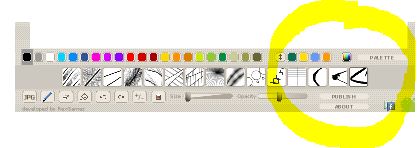
  • Or open a separate window in your browser to Pencil Madness, a free online sketching tool. (You can "deny" Adobe Flash permission to store information on your computer and still use the tool for this experiment.) If you're using Pencil Madness, click one of the three tools at the far right of the menu bar below the canvas.

  • Pencil Madness
     2. Launch a video: Click this link to launch an 8-minute video on splicing wool yarn and winding center-pull balls, or view it in the embedded player at the bottom of this post.

    3. Doodle while watching the video.

    4. Answer a few questions. Click this link to open a short survey. The survey is anonymous.

    Even if you don't watch the video or take part in the survey, I'd love to hear what you think: Does doodling enhance learning for you?


    Cross-Knit Looping: How To Splice Wool Yarn & Wind Center-Pull Balls from Donna Kallner on Vimeo.


    Tuesday, January 15, 2013

    Creativity, Community, Connection

    I'm inspired by my neighbor Marie. As far as I can see, she rises to any challenge with grace and good humor, but this one in particular strikes me as creative genius: You have a large but unknown number of cold, tired, hungry people and access only to what's in your own larder. Could you work a loaves and fishes miracle?  Marie does, with biscuits and gravy that are culinary works of art.

    This post is about creativity and community that's probably familiar to many of you. And I hope you'll share your own experiences in the comments section below. But to get my thoughts in order, here's what led to the telling of this story about community.

    As you may know, I live in a rural area with a small population scattered over a large geographic area. It's the type of place where firefighters and EMTs are all volunteers. My husband has served 25 years on a small department. Structure fires require assistance from neighboring departments.


    Last night, as the temperature slipped toward zero, Bill was paged out to a structure fire in a neighboring jurisdiction. On his way out the door he promised to assign himself a job that wouldn't aggravate the back pain he's had since Saturday.

    As he left, I was texting members of the our department auxiliary. Our newest member, Cindy, met me at the scene to pass out bottles of water, Gatorade and granola bars to firefighters. It was so cold, the Gatorade froze.

    At midnight, Marie and Jonita were serving biscuits and gravy, sandwiches, cookies and coffee to firefighters from a table in the house next door to the fire scene. None of us knew the owner who graciously opened her home.

    Many people from the community came together to take care of each other. One home was destroyed, but the people who lived there all got out. At this point, their story branches off, but my story about community continues -- online.

    After leaving the fire scene last night, I went home and worked for a couple of hours.

    First, I posted Lesson 1 for students registered in the Cross-Knit Looping eCourse. The roster includes both first-timers and returning students from across the U.S. and in Europe who share a fiber interest. But you know how it is: You learn who the dog lovers are, what other interests students share, whose life is complicated by medical concerns, who's planning an adventure. And you celebrate successes and discoveries together. In other words, it's a community.

    Next, I posted a few pictures I took on the fire department's Facebook page. Many people in the community have a limited understanding of what volunteers firefighters do. Much of what they do isn't exciting and it's virtually invisible: Two hours of repacking hoses, emptying creek water from the tanker and refilling it with clean water, going to town to get replacement parts for couplings that broke in the cold. Firefighters don't do all that to get their pictures tagged on Facebook. But their spouses, cousins, neighbors and friends who are on Facebook are proud to share that those pictures with their friends (or Friends, in Facebook parlance). 

    I see some of my neighbors more on Facebook than in real life. But you know what? I love that I can talk to someone I'm sitting next to about a picture of them I saw on Facebook. I love staying in touch with students who took fiber art workshops with me years ago. I love reconnecting with old friends from our canoe and kayak school days. I love keeping up with our godsons and a passel of kids who are interesting young adults now. And I love following the adventures of a group of women who became friends in a willow basketry class at Sievers lo, these many years ago. Those are the kind of friends who may not see each other for months or even years, then pick right up where we left off. That was true before Facebook. It's true with Facebook. And I'm sure it will be true After Facebook. I suspect it will be true after we're all just so much cosmic dust.


    Because what connects us isn't digital. It's the community we built. Together.

    As you may know, I'm taking an online course on e-learning and digital cultures. It doesn't start for a couple of weeks. So for now, I'm only guessing at how the course may impact my perception of "being human in the digital age," or how it might alter my approach to teaching online. Here's what I do know:

    What connects us is the community, not the carrier. It's what we build together that makes a difference in our lives.

    P.S. I would love to hear your stories of creativity, community and connection. Hit the Comments link below and say your piece. Thanks!


    Friday, January 11, 2013

    Acme Animations For Fiber Arts Instruction

    Today I played a little with animation in Gimp. I think it will take a LOT more practice before I can produce effective animated technique illustrations. But I'm seeing possibilities... and just a little queasy.

    This week, have you taken a first step toward learning something that's kind of a stretch? I'd love to hear about in the comments section below this post!

    Sign up for my email newsletter here.


    Monday, December 31, 2012

    New Year's Resolution

    Resolution #1: I've let my regular practice of creativity exercises lapse. The result feels like mental bloating similar to the physical effects of my culinary indulgences over the holidays. The treats are mostly gone and won't be replaced. I'm putting creativity exercises at the top of the to-do list for much of January. I'll post some of mine here, and hope you'll share your ideas as well.


    Resolution Number 2:


    Your comments on my last post helped me decide: We all have a stake in saying how we want to connect and learn online. So yes, I'll post some of my work in the upcoming class on e-learning and digital cultures here in 2013. And I look forward to your comments on those posts, too.

    What are your resolutions?

    Wednesday, December 26, 2012

    So Much To Learn -- And I Need Your Help!

    For many people, the last week of the year is a time for tying up loose ends. We clear out old files, discard mostly-empty jars of dried-up fabric paint, and donate leftover yarns and fabrics to thrift shops and guild exchanges. I'm doing some of that this week myself.


    But I need your help to get ready for one thing I need to do in 2013. First, here's the situation.

    I signed up to take an online class from the University of Edinburgh called E-learning & Digital Cultures. I already teach online classes (Cross-Knit Looping begins January 15 and New Age Looping Basics begins February 5). But in this fast-changing world, I know there's much to learn.


    I'm particularly interested learning ways to foster connections among students in online workshops. A handful of my fiber arts instructor friends are taking the class together so we can bounce ideas off each other.

    It's more than a month before the start of the class we're taking, and already students from around the world are connecting on Facebook, Twitter and other sites. They're already setting up study groups that will comment on each others' blog postings related to course material. But that got me thinking about whose opinions really matter to me. And the answer to that was easy: Yours.

    So when the class starts I plan to write about how things I learn can be applied to e-learning and digital culture in the fiber community. I'd like to post that writing here where I hope you'll comment on it, and maybe ask your friends to put in their two cents' worth as well. But I don't want to drive away readers who prefer I stick to topics like looping and natural dyeing and gift-making.

    So what do you think: Post here or not? Please hit the Comments link below and let me know. Thanks!