Showing posts with label teaching. Show all posts

Friday, February 8, 2013

Teaching Left-Handed When You're Not

Teaching left-handed when you're not is a great reminder of how students often feel -- awkward, uncertain, maybe anxious, or a little embarrassed. Between the e-course I'm teaching and the e-course I'm taking, this week I've felt all that.

With years of practice, I've learned to give reasonably fluid demonstrations of left-handed looping techniques, even though that hand is not naturally adept at the fine motor skills of manipulating a needle. And from years of teaching workshops in person, I know most of my left-handed students are adept at translating righty into lefty. So once the basics are established, most offers to show variations left-handed are met with, "No, thanks, I think I've got it."


Not this time. In my new cross-knit looping eCourse, I could tell from students' comments and questions that I needed to add a left-handed cross-knit edging video. Sighs of relief echoed across the interwebs when I said I would add one next week. They waited patiently. I shot it. I reshot it. And reshot it again. And finally, after two weeks, it went up on the course site.

Ginger Rogers made dancing with Fred Astaire look effortless, and she did it backwards and in high heels. In my own little fantasy world, I work to create a Ginger-esque sense of seamless fluidity in the content I produce for my eCourses. Sometimes, when I stumble (and I do) I save that footage for a gag reel at the end of a course.

Out of frame outtake 1
 Not this time. I've emptied a digital trash bin full of left-handed looping video. Such poor modeling could only confuse students further.

Back of my hand video -- not instructive.
Because I was so awkward, I kept moving the piece out of the camera's frame and closer to my bifocals. I hit the lens with my needle at least once.

Out of frame outtake2
In the end, here's what I had to do:
  • Practice. Unbelievably, I started shooting the first version without first warming up on a left-handed edging practice piece. Believably, it was painful to watch the playback of that footage. I deleted that stuff right away, then practiced before shooting Version 2.
  • Choose Easier Materials. I generally use different colors for right- and left-handed demonstrations to help me keep things straight in my head. Because I felt some time pressure on this video, initially I went with materials that were close at hand and "close enough." That was a waste of time. In left-handed demos, my most awkward moments (and this is saying something) are threading a needle and piercing anything with a needle (in this case, felt). Eventually, I got different felt. And I allowed myself to bury the tail (that piercing thing), with my right hand.
  • Alter The Progression. The most confusing part of this edging technique is the base row. It took me seven tries to record an acceptable left-handed base row. But I didn't begin with it in the edited video. Instead, I began in the middle, where my hand movements are smoother. With an audio dub, I explained: 
My left-handed demonstration skills are not as fluid as would like, so I'm going to start by showing how the stitching looks once you get going on an edging. Then we'll go back to how to begin and end.
In some ways, I think I'd like to alter the progression of the Massive Open Online Course I'm taking, too. And as an academic exercise, I can understand why the course is structured the way it is. But for much of the first two weeks I've felt like a lab rat in someone's Massive Open Online Research Project. It's not that I lack the wit or the will to operate in a self-directed learning environment. Frankly, I've done just that for years while cobbling together bits and pieces of references on a relatively obscure specialty. For me, that kind of learning generally produces excitement, anticipation, the thrill of discovery -- not the awkward, uncertain, anxiety I've felt in the #EDCMOOC.

In other words, I've felt like a right-handed stitcher demonstrating left-handed.

If I could alter the progression of the course, I would take some of the energy put into the first week's live chat session (recorded here), and put it into producing video introductions to aspects of the material by individual members of the instructional team. Yes, some students might hate the "sage on a stage" model. And they could ignore those course elements. As for me, I would appreciate some talking heads. Their absence feels too much like the reluctance of lab assistants to interact or influence their subjects.

In a class of 40,000 students, I don't really expect my comments or questions to result in an addition to the curriculum while the course is under way. But I do suspect the instructional team is feeling their share of anxiety about how this is going.

Unless they're too busy writing up lab notes about my behavior :-)

Tuesday, February 5, 2013

Kitchen Table Wisdom, And Show And Tell

Do you find that the greatest revelations occur when you're seated at your kitchen table talking with friends?

Jean and Connie
Two friends from my state's Surface Design Association came up Saturday for a play date in my studio.


We played with surface design media on inkjet fabric while we talked. Then we migrated from the studio table to the kitchen table, and talked some more. These two talented and generous practicing studio artists are also retired art teachers. I told them about my experience and frustrations with the Massive Open Online Course (MOOC) I'm taking now (E-learning and Digital Cultures). They asked questions, made observations, asked more questions. I nearly fell off my chair when, with their gentle guidance, I realized:
Duh. I've given students in the eCourses I teach instruction on how to post comments, questions and photos on the course site. But I've given them very little guidance on how to use reflective writing as a tool for learning and why they would want to do so.
As soon as I finish posting this bit of reflective writing, I'll email that observation and a couple more to the Gang of Four that hangs out at a virtual kitchen table built of four email accounts. They're fiber arts instructors who agreed to join me in this MOOC. (Becka calls them "conscripts." It's not inaccurate). 

We four are a tiny subset of the 42,000 people in the online class. Collectively, I'm sure that hive-mind could solve the problems of the universe, except that the answer would be lost in the babble. The Gang of Four, on the other hand, gets to the point. And I trust them (more than myself, to tell the truth) to sniff out B.S. dressed up in academic jargon and call it what it is. 

We're in the second week of the class we're taking, and even one more head-thumping revelation at either kitchen table will make the effort surpass "worthwhile." 

I have one more bit of kitchen table wisdom to share with you. Imagine I'm using my best Mom voice here: Always take something for show-and-tell. It's so interesting to see what others are learning and doing and what excites them. You never know how one thing you show can inspire someone else, or what will inspire you.


Connie, who was here this weekend, just returned from a Shino glaze pottery workshop, and it was fascinating to hear her talk about the variables that effect color when pieces are fired. I know absolutely nothing about pottery, but I could see all kinds of connections between her samples and things I do with natural dyes on fabrics, and constructed vessels of the textile sort.


Jean, a felter, showed samples from a workshop she took with Lisa Klakulak of Strongfelt and two of the genius tools she bought from Lisa. I've used "no running water in my studio" as an excuse long enough. Now I want to explore some of my constructed vessel techniques using felt instead of fabric laminates. I'm putting that on the calender to make time for it this fall.


Jean also brought some of her looping explorations worked in a beautiful spun flax using a variation I've heard called Danish Stitch. It's been a few years since I did much with this variation, and I've never really sampled it with a variety of materials. Add that to the calendar, too.

What's happening at your kitchen table? And what will you take for show and tell?


Thursday, January 31, 2013

Does Doodling Enhance Learning For You?

What do you do for 10 hours in an airport when one flight after another is canceled? Normally, I would pull out some stitching. But this week, weather-related travel delays gave me a block of time to study for an online course I'm taking. It helped that I found a relatively quiet spot, one private enough that I wasn't too embarrassed to move my lips as I tried to make sense of what I was reading.

Urban Garden at O'Hare International Airport
For those who are following posts about the Coursera E-Learning & Digital Cultures class (tagged #EDCMOOC), the first lesson included Marc Prensky's 2001 article Digital Natives, Digital Immigrants. I mostly got through it without moving my lips (not the case with the core reading). But what really helped was the visual reminder I got from studying in a seat beside the airport's urban garden:
  • There are different ways to achieve a goal (i.e. with and without soil).
  • Ideas, like plants, need time, resources, and care if they are to grow and flourish.
  • When resources are limited, you have to choose what you will nurture.
The most helpful (to me) element of the course so far came from a post in a class forum by a student, which led me to this video on "visitors and residents" and online engagement.

So what does all this have to do with doodling?

I got to thinking about how being tethered to my laptop precludes movement, which I find beneficial for learning (at all ages). I'm probably not coordinated enough to watch videos and interact with the class community while walking with a cell phone in hand. But some type of movement might be possible.

So will you help me with an unscientific experiment that will take about 10 minutes? I know that's a lot to ask, but you'll get to see a video unit from my Cross-Knit Looping eCourse and further the cause of fiber arts education. Here's what I'm asking:

1. Prepare to doodle using one of the following methods:

  • paper and pencil
  • air doodling with your finger
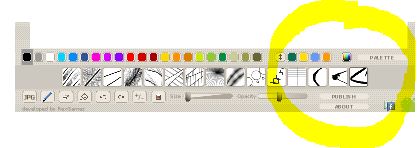
  • Or open a separate window in your browser to Pencil Madness, a free online sketching tool. (You can "deny" Adobe Flash permission to store information on your computer and still use the tool for this experiment.) If you're using Pencil Madness, click one of the three tools at the far right of the menu bar below the canvas.

  • Pencil Madness
     2. Launch a video: Click this link to launch an 8-minute video on splicing wool yarn and winding center-pull balls, or view it in the embedded player at the bottom of this post.

    3. Doodle while watching the video.

    4. Answer a few questions. Click this link to open a short survey. The survey is anonymous.

    Even if you don't watch the video or take part in the survey, I'd love to hear what you think: Does doodling enhance learning for you?


    Cross-Knit Looping: How To Splice Wool Yarn & Wind Center-Pull Balls from Donna Kallner on Vimeo.


    Tuesday, October 16, 2012

    Soon To Expire -- Brewed Dyes & Discounts

    Oops! I've been so focused on preparing for the natural dye workshop I'm teaching this weekend, I almost forgot a deadline. And it might be worth $300 bucks to you.

    Thrifted men's camel hair coat -- deconstructed, washed & ready for natural dye workshop
    If you're thinking of joining me for the Local Color: Ireland trip April 19-30, 2013, you can save up to $300 if you act by November 5. You get a $150 discount on the land portion of the trip if you make a deposit by that date. Celtic Journeys can negotiate a better rate on our lodgings if they're confirmed in November, and they pass that savings along to you. Also, if you pay in full by check instead of credit card by November 5, there's an additional $150 discount. The booking form is at http://www.celtic-journeys.com/locolreg.pdf. If you have any questions, please let me know or contact Maria Flynn Conway at Celtic Journeys.

    Today, I did send a heads-up to folks on my email list. (If you're not already on my list, you can sign up here to get those emails. It's a bit different from getting these blog posts by mail.)


    In the email, I included a couple of the interesting Ireland links I've been collecting. The Burren is one of our first destinations in Ireland, and the Burren land trust video above is fascinating. April should be a great time to see wildflowers there and elsewhere in Ireland. Here's a list of what might be blooming during the Local Color trip. And here's a list of some traditional Irish dye plants, which includes their Gaelic names.

    And now, I really must go finish prepping for this weekend's workshop. These students get the last jug of raithneach (bracken) dye brewed from fresh leaves.

    Raithneach a.k.a. bracken dye
    After this weekend, I'll be using the bracken that went into the freezer for winter dyepots. And Bill will be getting back a shelf in the homebrew refrigerator.


    Thursday, September 20, 2012

    Rocky Mountain Looping Adventure

    Why do I leave my camera in the bag in the back of the vehicle? The weather in Denver last weekend couldn't have been more perfect, and I don't have a single photo of the gorgeous mountain range at sunset to show you. But there were smiles as big as the Colorado sky on the faces of my lovely host and the program committee person for the Rocky Mountain Weavers Guild.


    The guild had invited me to do a lecture on looping and a couple of short workshops last weekend. After the lecture, I spoke briefly with Jean Scorgie, who, back in the early 1990's, wrote an article on cross-knit looping for Piecework. It was a pleasure to tell her how much help her needleknit finger puppets article was to me in my quest for looping knowledge. No photo, of course -- I was too busy talking.


    I did manage to get some quick shots of my students' work before everyone scattered. The afternoon after the lecture, we did skipped stitch looping using wool yarn over bars of soap. With use, the wool will felt and their projects will evolve into lacy little felt bags.


    During Sunday's Burundi looping class, the chorus of ideas I heard for how students planned to use their new skills was music to my ears.


    The lecture and workshops were held at TACtile, which had the Studio Art Quilt Associates Regional Members' Showcase on exhibit.


    TACtile is located above the JHB Button Museum, so I had a few minutes to indulge my love of buttons, thimbles and vintage stitching paraphernalia.


    One of my students graciously checked out three books from the guild library so I could look at them overnight. I could hardly keep my eyes open, but read enough to know I need to be looking for copies of these Anne Bliss titles for my personal library.

    That's a logical place to break and come back next time with more on natural dyeing. But first, I just have to say how much I enjoy the people I meet on these little adventures. This time, I met someone with an adult child in circus school in Australia (her own world adventures as part of a handbell choir were fascinating in their own right). I've met people who have visited the South Pole, danced on American Bandstand, worked for Barbie (THE Barbie), and had all kinds of fascinating experiences.

    Monday evening I got home tired and happy. My husband was vacuuming and had sheets on the bed for a visit from his brother and sister-in-law, who arrived shortly after I did. We had a lovely couple of days with our company, and I'm just now starting to share with him the stories from Denver. I must remember to tell him about the snow bike.

    Seriously -- next time, back to natural dyeing!

    Wednesday, August 15, 2012

    A Love Affair With Learning

    Last week, six other instructors and I taught at the Michigan League of Handweavers 2012 Summer Workshops event at Hope College in Holland, Michigan. And what did the teachers talk about outside of class? What good students we all had! When a guild consistently gets 25 percent of its members into its 3-day workshops, you know it's a group that places a high value on learning.


    In my Digital Fabric class, there was hardly a minute to spare for taking pictures of the class, bud I did catch a couple of my students (and volunteer event organizers) on the way to lunch one day. And I got some shots of the buildings behind them to use in a class demo.


    During a quick tour of the studios on Saturday night, I managed to take a few more photos.


    Wynne Mattila taught a Finnish rag rug workshop. I became a fan of Wynne's last year, when I was on the awards committee at Midwest Weavers Conference. Her Aurora won the prestigious Handwoven magazine "Weaving For The Home" award.


    Her very cool alternating 3-shuttle technique had me thinking of ideas for looping, and her students' color choices had me thinking of palettes for digital fabric design.


    Juliane Anderson taught Becoming A Confident Weaver. This kind of personalized skill-building class is a great addition to a conference schedule, and Juliane seems to project an aura of gracious calm and resourcefulness perfect for this type of class.


    The gorgeous freeform knitting she showed during the Friday night "meet the teachers" program had me anything but calm! I love freeform looping but haven't spent any time on freeform knitting. That's a workshop I'd love to take with Juliane.


    Rebecca Mezoff was visiting other classrooms when I popped into hers that night, so no picture of her. But her students' work with color gradations in tapestry was amazing, and I really enjoyed her Friday night presentation about her own work and her work with James Koehler.


    I have a feeling the wool she dyes is a pretty accurate reflection of Rebecca: You know it's lovely with just a glance, and a closer look reveals even greater depth and complexity, which certainly shows in her work. Since none of my pictures do any kind of justice, do go to her gallery page and see for yourself.


    At the end of the conference I had hoped to get back to Jennifer Moore's Doubleweave classroom to see her students' work off the looms, but didn't make it. I Gimped this too-dark photo a bit and hope you can get a sense of how very exciting it was to see her class's works in progress. Hang on -- it gets even better:


    Here are the doubleweave samples Jennifer brought to class. And that photo shows only one side of the collection, so it's twice as exciting in person.


    It was a treat to teach with fellow Sievers instructors Mary Sue Fenner and Chad Alice Hagen, but of course we never got a picture of us together. Mary Sue let me try on a vest from the sample collection she brought for her One-of-a-Kind Fiber Arts Jacket class, and I almost didn't take it off.


    She's making a vest with some of my Spoonflower fabrics for The Gathering at Sievers the last weekend in September, and we hatched a plan for a steampunk ensemble for later. She'll do the corset and bubble skirt with my fabric, I'll make the bowler and goggles, and unless I become taller and thinner I'm counting on her to model the ensemble.


    Chad Hagen and I were teaching practically next door, but I only got into her classroom twice -- once to steal a marker I never returned and late the last day, when I stole in to take this shot of an Airey Fairey Scarf WIP. But as always it was great fun to see her and hear tales of her adventures. Chad is a gifted storyteller, and she had the audience in stitches on Friday night talking about her felting. Then she starts talking about what she's been learning. Papermaking. A natural dye workshop with Michel Garcia. You can practically see sparks flying off the wheels turning, and I suck that up like an energy vampire.

    And that's just the instructors at this event. Every time I sat down at a meal and talked with someone new I found more love of learning, more excitement, more inspiration.


    The drive back north to Mackinaw and across the Upper Peninsula gave me time to reflect on some of that and plot my fall and winter. More on that soon. In the meantime, it's great to be home!

    Monday, August 6, 2012

    When It's Not A Race

    Over the weekend, I found myself this close to the finish line on a big task. Then my bobbin thread ran out. After a moment of frustration, I thought how silly that was compared to the Olympic triathletes who had to change bicycle tires during their race. I love the Olympics. Puts things in perspective.

    I've been sewing the proofing swatches of my Spoonflower fabric designs into sample collections, both for my own reference and to make it easier to illustrate concepts in my Digital Fabric workshops. I teach that again this week for Michigan League of Handweavers. And I have plenty of samples. So I didn't refill the bobbin and kick for the finish line. Instead, I got wash off the clothesline, went for a walk with Bill and Scout, and watched the Olympics again.

    Sometimes it feels like the clock is always ticking and the to-do list never gets shorter. It's August and unpulled weeds have set seeds. I haven't started the deck project. And my ambitious summer dyeing plans? Those withered on the vine.


    But I did get a staghorn sumac dyebath brewed from Bill's leftovers. We gathered last week for a batch of wine. Bill scraped the fuzzy berries for wine, and I got the staghorn stalks and leaves for dyeing. After a couple days of soaking in Mom's aluminum jelly kettle, I put the kettle on the stove to barely simmer for an hour or so. Yesterday I strained the liquid, but I haven't dyed with it yet. It looked like there's color left, so I put the solids into bags in the freezer to deal with later. Maybe when I'm back from Michigan.

    Probably not. I need to do the things its been too hot and busy to do before it gets too cold.

    In the meantime, I'll be watching the Olympics and celebrating the achievements of all the athletes who made it there, whether they get to stand on a podium or not. 

    Wednesday, June 27, 2012

    Willow People

    Wonderful, inspiring willow people came together last week in Decorah, Iowa, thanks to the efforts of Jo Campbell-Amsler and Lee Zieke Lee. I don't think I can sum up how important and fun this Willow Gathering was. I'll have to break it into several posts while I do laundry and prep class materials for my class at Sievers next week. So stay tuned for more about Decorah (amazing), the coracle launch, the workshops I taught, the other workshops, my new willow brake, and more. In the meantime, I put a photo album on Facebook and others from the conference are posting pictures as well.

    International Willow Summit
    For now, let me just say the key ingredient in this conference was the people. Generous, knowledgeable people from across the U.S. and Canada came together to learn and share. It was a wonderful mix of old friends, new friends, and people I've only known from online.

    Lene Rasmussen of Lakeshore Willows
    Katherine Lewis at Willowglen
    Joanna Schanz, Sandy Whalen and Karen Tembreull in Katherine Lewis's Scottish Rope Coil class

    Pam Talsky and Sandy Whalen
    Jo Campbell-Amsler and Lee Zieke Lee

    Photo op at Luther College -- a cool moth under the eave
    As usual, I meant to take more photos then got busy setting up and teaching classes (and eating -- great food!). I wish I had better pictures of some of these beautiful people, or that you could see the pictures in my head!

    More soon.


    Tuesday, May 22, 2012

    Burundi Looping, Learning And Laughter

    There's a special kind of magic that happens when guild members get together to learn something new. An alchemist might be able to produce a similar effect (like turning lead into gold) from a recipe that combines lovely people, love of learning, and intention to make time for guild activities. When you factor in laughter, show and tell, yummy treats, and good lighting, the result is definitely magical.


    The Flambeau Area Fiber Artists invited me to Ladysmith, Wisconsin, to teach Burundi looping last weekend. Eight people signed up for the class, which is a considerable leap of faith for a guild whose members are so geographically dispersed -- especially considering nobody really knew what Burundi looping was!


    So here's the short version: "Burundi looping" is the name I use to identify a particular complex looping variation in which each stitch intersects with multiple previous rows. I learned it from Peter Collingwood's book, The Maker's Hand. Peter's example was a bag he collected in the African nation of Burundi. In looping, there's a strong tradition of identifying stitch variations with the places where they're used (or found). So for years, I've called this variation Burundi looping.


    This structure is much less elastic than simple looping. And at a glance, it would be tough to identify it as single-element construction, let alone as first cousin to the most basic form of knotless netting. It looks more like a woven twill.

    This is a workshop I love to teach. It includes a lot of technique, but the progression makes perfect sense and the combination of skills can be applied a lot of different ways, once you know them, and with many different materials.


    The most disappointing thing about the workshop was that, once again, I didn't think to take more pictures. Right now, I'm really wishing I could show you a photo of Nancy and the double-weave pick-up coaster fabric she brought for show and tell. She wove as an "in between" project, for Pete's sake!

    That's the kind of passion I see all the time in guild members. That's the kind of passion that inspires me.


    Friday, May 11, 2012

    Extreme Sampling With Illinois Prairie Weavers

    In my view, sampling workshops are right up there with dark chocolate and salty snacks: I love them! As a student, I appreciate the opportunity to try things I might not wrangle together on my own. As a teacher, watching ideas start to flow when students discover new techniques is so much fun I forget all about dark chocolate and salty snacks.


    This week, I got to play the Illinois Prairie Weavers. First, the whole group heard my spiel on sharing stories through textiles (a.k.a. my Complete Fabrication lecture).


    They'd already done a bang-up job of telling their stories during their show-and-tell before the lecture. That's the line-up of people ready to share their beautiful work with the group.


    And this is show-and-tell work spread out for a closer look after the program.


    My lovely host wore a formerly white handwoven silk vest she had overdyed with pink acid dye. When I left her house, that vest was soaking in the sink ready to go into the indigo vat for its next incarnation. She's planning to keep adding surface design alterations each month to wear to guild meetings. I'm hoping to see pictures of the vests evolution.


    As usual, I was too busy to take a single picture once I started teaching the dry techniques part of the workshop that afternoon. But here's what the kit looked like before I packed up and left home. In a whirlwind of sampling, the group got an introduction to the possibilities of some pigment-dye products and disperse dyes (with a side of inkjet heat transfers and inkjet fabrics).


    The wet workshop was held the next day in my host's garage, where running water was just a few steps away (a luxury compared to my own studio). As usual, the day was almost over before I thought to reach for my camera. By that time we had set up a vat of pre-reduced indigo, steamed acid dye samples, dipped a lot of samples in blue dye, and discovered one leaky glove!

    While Inkodye samples were developing I did get a few shots. This may be my favorite student photo ever: Four classes of dyes, 38 samples over two days -- and they're still smiling!

    When I left, the students were planning the extreme sampling show-and-tell they'll do at their next guild meeting, and how they might use techniques they had learned. That put a smile on my face that stayed there through the drive home and the unpacking.

    Now I'm off to build a thread-winding jig inspired by two my host has made, neither of which I took pictures of. Really, why is it so hard to remember to take three seconds to take a snapshot?