Showing posts with label eCourse. Show all posts

Thursday, February 14, 2013

Are You A Bronze Bobby Pinner, Too?


Last week, one of my students in the Cross-Knit Looping eCourse posted this comment:
I made a couple of hearts yesterday, using the flat panel technique. We spent the day in Minneapolis. I took my looping supplies. When I sat down to get started, while Gordon did some maintenance at our daughter's apartment, I realized I had not included tapestry needles in my looping bag. I stitched two hearts using a bobby pin instead of a tapestry needle. It worked, but I don't recommend it! Do I get an A for effort, teach?
A for effort, a gold star, high fives, and the 1st Annual Bronze Bobby Pin Award!

Val Tindall's Bronze Bobby Pin Heart

Later, Val shared a picture of her homework project and this:
This is the heart that I completed. The red looping was done using a bobby pin in place of my forgotten tapestry needle. I was bound and determined to get my homework done. The edging was done with the needle. I did give it a bit of stuffing between the silk backing and cross-knit lopped front. I did stitch a pin to the back. My other bobby pin sample heart is tied to our daughter's collar.
That's how the Bronze Bobby Pin Award began. Congratulations, Val, and thank you for inspiring us all!


Do you have a resourceful, can-do attitude, too? Are you the type of person who could rip up a floorboard to find a needle, or stitch with a bronze bobby pin, if necessary? If you are, grab a Bronze Bobby Pin badge from the sidebar and share your story in the comments below. We <3 inspiration!

Thursday, January 31, 2013

Does Doodling Enhance Learning For You?

What do you do for 10 hours in an airport when one flight after another is canceled? Normally, I would pull out some stitching. But this week, weather-related travel delays gave me a block of time to study for an online course I'm taking. It helped that I found a relatively quiet spot, one private enough that I wasn't too embarrassed to move my lips as I tried to make sense of what I was reading.

Urban Garden at O'Hare International Airport
For those who are following posts about the Coursera E-Learning & Digital Cultures class (tagged #EDCMOOC), the first lesson included Marc Prensky's 2001 article Digital Natives, Digital Immigrants. I mostly got through it without moving my lips (not the case with the core reading). But what really helped was the visual reminder I got from studying in a seat beside the airport's urban garden:
  • There are different ways to achieve a goal (i.e. with and without soil).
  • Ideas, like plants, need time, resources, and care if they are to grow and flourish.
  • When resources are limited, you have to choose what you will nurture.
The most helpful (to me) element of the course so far came from a post in a class forum by a student, which led me to this video on "visitors and residents" and online engagement.

So what does all this have to do with doodling?

I got to thinking about how being tethered to my laptop precludes movement, which I find beneficial for learning (at all ages). I'm probably not coordinated enough to watch videos and interact with the class community while walking with a cell phone in hand. But some type of movement might be possible.

So will you help me with an unscientific experiment that will take about 10 minutes? I know that's a lot to ask, but you'll get to see a video unit from my Cross-Knit Looping eCourse and further the cause of fiber arts education. Here's what I'm asking:

1. Prepare to doodle using one of the following methods:

  • paper and pencil
  • air doodling with your finger
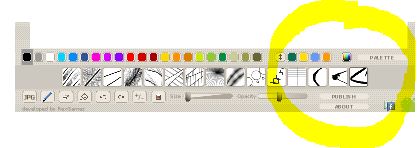
  • Or open a separate window in your browser to Pencil Madness, a free online sketching tool. (You can "deny" Adobe Flash permission to store information on your computer and still use the tool for this experiment.) If you're using Pencil Madness, click one of the three tools at the far right of the menu bar below the canvas.

  • Pencil Madness
     2. Launch a video: Click this link to launch an 8-minute video on splicing wool yarn and winding center-pull balls, or view it in the embedded player at the bottom of this post.

    3. Doodle while watching the video.

    4. Answer a few questions. Click this link to open a short survey. The survey is anonymous.

    Even if you don't watch the video or take part in the survey, I'd love to hear what you think: Does doodling enhance learning for you?


    Cross-Knit Looping: How To Splice Wool Yarn & Wind Center-Pull Balls from Donna Kallner on Vimeo.


    Friday, January 18, 2013

    Recycling: The Camel Hair Coat Chronicles

    There are only a few pieces left from the man's camel hair coat I bought at Goodwill last fall. Students in a natural dye class last fall used most of the coat. I kept the parts that were gunky with fused interfacing.


    Some of that got used in a project for the Cross-Knit Looping eCourse that started this week. Registration for XKL closes tomorrow, but you can still get into New Age Looping Basics, which begins February 5.


    Students will see it in Lesson 2, which posts next Tuesday.


    I love working with this camel hair fabric and wish I had more. But I'm not even tempted to contribute my own camel hair coat to the cause. It was my mom's playground duty coat. When she retired from teaching, she gave it to me. It has to be 25 or 30 years old but it's still my go-to coat for dressy occasions and any occasion when temps are sub-zero.

    You may see a picture of it next week.

    I guess it's time to scour the thrift shops for another camel hair coat.

    What kind of recycled materials are you on the hunt for? And what's your best thrift store find?

    Sign up for my email newsletter here.

    Tuesday, January 15, 2013

    Creativity, Community, Connection

    I'm inspired by my neighbor Marie. As far as I can see, she rises to any challenge with grace and good humor, but this one in particular strikes me as creative genius: You have a large but unknown number of cold, tired, hungry people and access only to what's in your own larder. Could you work a loaves and fishes miracle?  Marie does, with biscuits and gravy that are culinary works of art.

    This post is about creativity and community that's probably familiar to many of you. And I hope you'll share your own experiences in the comments section below. But to get my thoughts in order, here's what led to the telling of this story about community.

    As you may know, I live in a rural area with a small population scattered over a large geographic area. It's the type of place where firefighters and EMTs are all volunteers. My husband has served 25 years on a small department. Structure fires require assistance from neighboring departments.


    Last night, as the temperature slipped toward zero, Bill was paged out to a structure fire in a neighboring jurisdiction. On his way out the door he promised to assign himself a job that wouldn't aggravate the back pain he's had since Saturday.

    As he left, I was texting members of the our department auxiliary. Our newest member, Cindy, met me at the scene to pass out bottles of water, Gatorade and granola bars to firefighters. It was so cold, the Gatorade froze.

    At midnight, Marie and Jonita were serving biscuits and gravy, sandwiches, cookies and coffee to firefighters from a table in the house next door to the fire scene. None of us knew the owner who graciously opened her home.

    Many people from the community came together to take care of each other. One home was destroyed, but the people who lived there all got out. At this point, their story branches off, but my story about community continues -- online.

    After leaving the fire scene last night, I went home and worked for a couple of hours.

    First, I posted Lesson 1 for students registered in the Cross-Knit Looping eCourse. The roster includes both first-timers and returning students from across the U.S. and in Europe who share a fiber interest. But you know how it is: You learn who the dog lovers are, what other interests students share, whose life is complicated by medical concerns, who's planning an adventure. And you celebrate successes and discoveries together. In other words, it's a community.

    Next, I posted a few pictures I took on the fire department's Facebook page. Many people in the community have a limited understanding of what volunteers firefighters do. Much of what they do isn't exciting and it's virtually invisible: Two hours of repacking hoses, emptying creek water from the tanker and refilling it with clean water, going to town to get replacement parts for couplings that broke in the cold. Firefighters don't do all that to get their pictures tagged on Facebook. But their spouses, cousins, neighbors and friends who are on Facebook are proud to share that those pictures with their friends (or Friends, in Facebook parlance). 

    I see some of my neighbors more on Facebook than in real life. But you know what? I love that I can talk to someone I'm sitting next to about a picture of them I saw on Facebook. I love staying in touch with students who took fiber art workshops with me years ago. I love reconnecting with old friends from our canoe and kayak school days. I love keeping up with our godsons and a passel of kids who are interesting young adults now. And I love following the adventures of a group of women who became friends in a willow basketry class at Sievers lo, these many years ago. Those are the kind of friends who may not see each other for months or even years, then pick right up where we left off. That was true before Facebook. It's true with Facebook. And I'm sure it will be true After Facebook. I suspect it will be true after we're all just so much cosmic dust.


    Because what connects us isn't digital. It's the community we built. Together.

    As you may know, I'm taking an online course on e-learning and digital cultures. It doesn't start for a couple of weeks. So for now, I'm only guessing at how the course may impact my perception of "being human in the digital age," or how it might alter my approach to teaching online. Here's what I do know:

    What connects us is the community, not the carrier. It's what we build together that makes a difference in our lives.

    P.S. I would love to hear your stories of creativity, community and connection. Hit the Comments link below and say your piece. Thanks!



    Wednesday, December 26, 2012

    So Much To Learn -- And I Need Your Help!

    For many people, the last week of the year is a time for tying up loose ends. We clear out old files, discard mostly-empty jars of dried-up fabric paint, and donate leftover yarns and fabrics to thrift shops and guild exchanges. I'm doing some of that this week myself.


    But I need your help to get ready for one thing I need to do in 2013. First, here's the situation.

    I signed up to take an online class from the University of Edinburgh called E-learning & Digital Cultures. I already teach online classes (Cross-Knit Looping begins January 15 and New Age Looping Basics begins February 5). But in this fast-changing world, I know there's much to learn.


    I'm particularly interested learning ways to foster connections among students in online workshops. A handful of my fiber arts instructor friends are taking the class together so we can bounce ideas off each other.

    It's more than a month before the start of the class we're taking, and already students from around the world are connecting on Facebook, Twitter and other sites. They're already setting up study groups that will comment on each others' blog postings related to course material. But that got me thinking about whose opinions really matter to me. And the answer to that was easy: Yours.

    So when the class starts I plan to write about how things I learn can be applied to e-learning and digital culture in the fiber community. I'd like to post that writing here where I hope you'll comment on it, and maybe ask your friends to put in their two cents' worth as well. But I don't want to drive away readers who prefer I stick to topics like looping and natural dyeing and gift-making.

    So what do you think: Post here or not? Please hit the Comments link below and let me know. Thanks!


    Monday, December 10, 2012

    5-Panel Project Bag -- Knitting + Crochet + Looping

    Suppose you took Mastadon Stew to a potluck and someone asked for the recipe. OK, that wouldn't happen because, well, mastadons are extinct. But when you're asked for a recipe or pattern for something made with an ancient technique that's not extinct but is comparatively obscure? Something like cross-knit looping? Thank goodness for the internet, where you can link to references and inspirations.

    Cross-knit looping is worked with a single needle and is incredibly portable and forgiving of interruptions. It's great for covering up selvedges and seamlines on knitting, crochet, weaving and felt, adding a lovely design element that also helps add structure and/or stabilize edges.
    Donna Kallner's 5-Panel Project Bag made with naturally-dyed yarns includes knitting, crochet and cross-knit looping
    Last fall, a student asked if I would share the pattern for this project bag. On things I make for myself, my "patterns" are much like most of my cooking recipes: I generally don't record specific quantities, but I can tell you how I make something ("cook brown rice and some black beans with cumin and garlic, cool, dress with orange juice viniagrette, add some fresh sweet corn, onion, red pepper, maybe grilled zucchini...."). I assume you'll adjust proportions to your own tastes and materials/ingredients anyway.

    So here's the "recipe" for my drawstring project bag.

    5-Panel Drawstring Project Bag
    • Knit 2 panels for the front and back of the bag. Mine are 6" wide x 5" tall. I knit one in garter stitch. For the other side, add variety to a panel of stockinette stitch by making intermittent rows of knit to make garter stripes.
    • Knit 2 panels for the sides of the bag. Mine are 3-1/2" wide x 5" tall. One is knit in loose 2/2 ribbing (casting on for the 5" dimension). The other is seed stitch (odd rows are knit1, purl 1; even rows are purl 1, knit 1).
    • Crochet a bottom panel. Mine is 6" wide x 3-1/2" deep. I used single crochet to make a firm bottom.
    • Sew or slip stitch crochet one edge of each upper panel (front, back and sides) to the base. 
    • Attach edges of upper panels to form the bag.
    • Crochet a few rows (or more) around the top of the bag to make a rim.
    • Crochet a drawstring channel by skipping stitches and making long posts. 
    • Add another row or two of crochet above the drawstring channel to complete the rim.
    • Braid or chain two drawstrings long enough to travel the circumference of the bag.
    • Thread one drawstring through the channel all the way around the rim of the bag. Tie off and add a small tassel, if you like.
    • To thread the second drawstring, begin on the opposite side of the bag from where you started with the first one.
    • Work cross-knit looping over the seam that connects side panels to the base. I learned this application for cross-knit looping from Laverne Waddington. This and many other uses of cross-knit looping are included in my new eCourse, which begins January 15. (There's a short video trailer here, and registration is open here).
    • Work cross-knit looping over the seam where the side panels meet the rim. 
    Cross-knit looping masks the seams where panels meet and adds contrast in color, line and texture.
    Apply whatever variations strike your fancy. You could make the panels and rim all knitting, all crochet, or even all looping. I chose to combine knitting and crochet because I wanted to show something familiar to knitters and crocheters who might be enticed to try looping. You could make a little gift bag from old swatches used to determine gauge for knitting projects. Or use panels of felt or fabric for the base and sides.

    Make the bag any size you like. I chose this size because it would hold just one project and fit beside me on the seat while traveling (I have a tendency to overpack given a larger bag). On a larger bag, though, I might cover all the vertical seams that join panels with cross-knit looping. That would add some structure to help the bag stand up.

    Sadly, it appears that the Licorice Twist yarn I used is no longer available from Dharma or anywhere else I can find. The main body of the bag was immersion dyed with willow bark and walnut. The yarn for the cross-knit edging is from a ball I've been hoarding for years since I took a natural dye class at John C. Campbell Folk School. I think it was from Knit Picks, and I think it was dyed with lichen then overdyed with indigo.

    In other words, the exact materials I used are not available for you to make an exact replica of this bag, and that's a good thing. You'll come up with something of your own that uses the materials you have beautifully.

    I'd love to see what you make! Please, please post pictures of your variations on this recipe on my Facebook page.


    Friday, December 7, 2012

    Registration Open for Cross-Knit Looping eCourse

    It's official: Registration is open for the my newest eCourse, Cross-Knit Looping. The technique is sometimes called Coptic knitting, Tarim stitch or Viking knit (that's right -- the fine silver jewelry is the same structure). Cross-knit is part of a large family of looping techniques. It can look so much like stockinette stitch that early artifacts were often misidentified as knitting. But it's pure looping: The entire length of the thread is pulled through on each stitch, and it can't unravel like knitting.

    Click to go to eCourse registration
    Cross-Knit Looping runs January 15-February 28, 2013. Here's a short video trailer I made for the eCourse.


    There's more info and you can register for the class here.

     Like other forms of looping, cross-knit can stand entirely on its own. But it marries so beautifully with knitting, crochet, weaving and felt that I've included some fusion projects in the course. And I think handspinners and dyers will absolutely love this technique.

    Cross-knit looping sun tea jar cozy and water bottle caddy (with felt)
    Knit neck warmer with cross-knit looping placket and buttons
    I really need a model to photograph instead of trying to shoot myself in the mirror. Incidentally, these pictures show projects done with my naturally dyed yarns. There are yarns straight from my LYS used in the course, as well.

    Donna's project bag -- knitting, crochet, and cross-knit looping
    One of my Sievers students this fall (Roseann?) asked for a recipe (in lieu of a pattern) for the drawstring project bag pictured above. I'll post that next time.

    Saturday, November 24, 2012

    The Video Studio

    After a short break to celebrate Thanksgiving with family, I'm back to work on a new eCourse on cross-knit looping, which I'll tell you more about soon. In the meantime, here's a peek at my new video "studio."


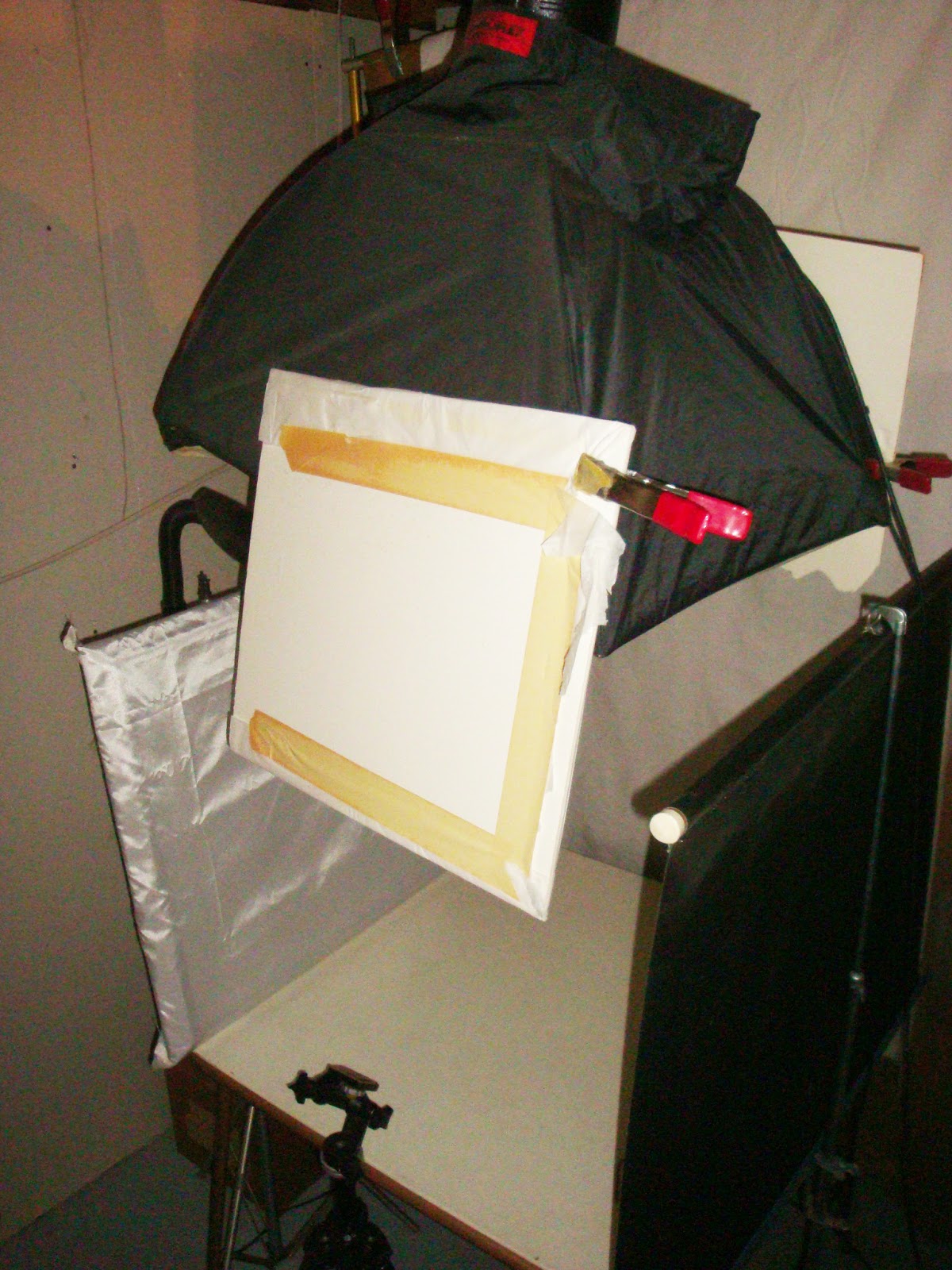
    The homemade diffuser on the left is fabric stretched on an old picture frame. On the right is an old slide projector screen I found at the thrift shop. The white top on the card table (a family heirloom from the 70's) is easier for shooting than the fabric-covered table I used before. You can't really see the fabric backdrop or the two bounce lights. But here's the key element:


    That black tent-like thing at the top covers a modeling lamp that gives diffused light from overhead. A friend who's a professional photographer helped me set up a photo studio back in the late 1990's, when I was still shooting my work on 35mm slides. I think we traded her a canoe for equipment, help setting it up, and lessons on how to shoot with it. Once I went digital, the flash didn't sync with my camera. It didn't occur to me until recently (duh) that I could use the modeling lamp without the flash.

    The new set-up is tucked into a small space in our basement between the utility room and the cold room where we store squash and homemade wine. There isn't quite enough space to shoot the short "talking head" segments of the course, but it's working great for the close-up shots of my hands demonstrating techniques.

    Speaking of hands, I stained my right hand with black walnut dye when my glove sprung a leak while I was doing "just a quick project." So no more dyeing until the last of the video is shot and edited!

    Saturday, June 2, 2012

    DIY Waxed Linen

    The students in the spring session of my New Age Looping Basics eCourse have been very interested in learning to paint and wax their own threads.


    Last month, I posted a short video I made for them on how to paint commercially produced waxed linen. Here's another short video I made for them showing how I wax my hand-dyed linen thread, and how to wind the waxed thread into a center-pull ball.


    As this session of the eCourse draws to a close, students are getting the last of their projects posted and sharing lots of great tips, ideas and inspirations. I'll be sorry to see the class end, and hope they'll continue to share on the New Age Looping Study Group on Facebook.

    A new session of the eCourse is scheduled for September 11 - November 1. Registration is open now. I wonder what special interests the next group will have?


    Monday, March 12, 2012

    Ombre Or What Would You Call It?

    Ombre thread included in New Age Looping Basics eCourse starter kit
    For looping, I like threads that give me color with some highlights and depth -- something more subtle than space-dyed yarns, which are often a bit stripey. The term I came up with for these hand-dyed fibers is ombre, but what do you think?

    I've always understood ombre (sorry, can't figure out how to accent the e) to refer to a yarn or fabric that varies in shade or tone. But just to be sure, I googled the term to check my usage while writing the description of materials in the starter kit for my New Age Looping Basics eCourse. What I found wasn't what I expected. But now I know that ombre is the latest rage among celebrity hair styles.

    Years ago, when my passion for dyeing mostly applied to Easter eggs and my own hair, the dip dyed look was something to avoid. I won't be posting pics of my bleached blonde days. Just assume I looked very, very cool.

    Maybe we should put our heads together (whatever color they may be now), flip through some old photos for styles we never expect to see again, and try to come up with the Next Big Thing. Any ideas?


    Thursday, March 8, 2012

    A Digital Fabric Video And Pffft At Perfectionism

    The work I've been doing lately isn't very photogenic, and I'm not sure how to make "timestamping" videos sound worthy of a gasp and pleas of "do tell!" But I'm chipping away at details (soon to be posted here) and plan to offer the New Age Looping Basics eCourse again in April. Thank you to the pilot group who tested the course in January!


    Another pilot group, a smaller one, helped me out last fall by reviewing this video I made while I was just learning to use some of the editing tools I've spent so much time with lately. Now when I look at this video I think, "Oh, I could do so much better." But I'm posting it as is and hope you'll join me in celebrating the process of learning and the joy of seeing improvement.

    There's no admission charge at this "screening," but I'd love it if you'd hit the Comments button below and share something you're proud of learning!

    Thursday, February 2, 2012

    Rewind And Fast Forward

    from Lesson 3 of the New Age Looping Basics eCourse with Donna Kallner
    So much of my time lately has been focused on production and testing of the New Age Looping Basics eCourse that other things, well.... Let's just say it's time for some housecleaning. Since you can't see my shower but you can see this blog, I started cleaning here first. And then it turned into a rewind.

    I'm rewinding back to a traditional blog format. I liked the appearance in Dynamic Views, but functionally it just wasn't working. So we're back to something I hope will work better for you than having to make a visual scan of pictures and the first few sentences of a post to find what you want. In other words, the right-hand column list of categories is back, and I've added a search box that should work more than 10 percent of the time.

    I've updated my Workshops page to let you know where I'm teaching this year. I think there are a still a couple of spaces in the Willow Spirit Constructed Vessels workshop at the Willow Gathering in Decorah in June. Maybe I'll see you there! And 2012 Sievers class registrations opened yesterday, so maybe I'll see you in Digital Fabric or Local Color.

    This blog housecleaning project isn't quite complete (when are they ever?). I still plan to clean up the overflowing Pages (the bar under the header). So I'll be reprinting here some of the creativity exercises that first appeared on my old blog, Compost and Creativity. That way they'll appear in searches and categories here. No, you're not losing your mind if you think, "Haven't I read that before?" But it feels like a good time to revisit those creativity exercises and rituals, and to share a few new ones.

    In the meantime, which mode are you in right now -- rewind or fast forward?

    Thursday, January 19, 2012

    Cute Or Creepy?

    While developing lessons and projects for my New Age Looping Basics eCourse, I considered including a doll form made from an oval base.


    It's a great project for learning. These forms feel, to me, like something much older than the amigurumi so popular now. They touch an ancient chord in me. But that's me. What do you think?

    Thursday, January 12, 2012

    I'm Listening


    It's the first week of the New Age Looping Basics eCourse! Members of the pilot group are busy watching videos, downloading PDF handouts, stitching samples and posting their questions and pictures on the course site. And they're giving me great feedback on how to improve the course -- like the request for the illustration above.

    I'd like your feedback, too! What can I do to make Two Red Threads better?

    Wednesday, December 14, 2011

    Does This Revise Your To-Do List?

    December is a month for impossible to-do lists that look something like this:
    • Select and/or make perfect gifts for everyone.
    • Wrap those perfect gifts creatively, beautifully, inspired-ly.
    • Decorate home (interior and exterior) perfectly so it accurately reflects a) love of family, b) love of season, and c) love of Martha.
    • Turn oven to preheat for perfect baking every time you enter the kitchen.
    • Spend time with family and friends making perfect memories.
    We all know that's impossible, don't we? Does that stop us from trying to attain at least a few of those impossible goals -- and work, too? Um, don't answer that.


    This year, I decided to post a Daily Doodle on my Facebook page every day in December. It was my commitment to myself to spend five minutes a day during the season of impossible goals to do something that's doesn't aspire to perfection -- just a simple little doodle on a 3x5 index card. I missed one day, which I blame on the sugar coma induced by overconsumption of Christmas cookies. But on the whole it started off as a very do-able and enjoyable routine in a month where routine is turned on its head.

    And then I did something insane: I thought, "Why not take this opportunity to practice doodling with the Wacom tablet I bought last summer and haven't taken out of the box?"


    On the one hand, I've enjoyed spending a few minutes a day away from Etsy selling and gift making and preparations for an upcoming eCourse -- just starting to learn how to use this new tool. On the other hand, I find myself on a slippery slope that leads toward a midden pile of impossible goals: I seem to expect more perfection from something made using an unfamiliar device that has to be plugged in than from something made by my own hand in the few minutes it takes for the oven to preheat.

    Over the weekend, I put away the tablet, went back to index cards, and got some perspective. I may still be insane, but I have some perspective on my craziness. In other words, I got my tongue unstuck from the frozen lamp post that pops up when I double dog dare myself to try something new in the presence of witnesses.

    And then today, a holiday miracle arrived, via Liz Massey's Creative Liberty: Liz shared The Done Manifesto by Bre Pettis and Kio Stark. Here are my favorite elements.
    #6 -- The point of being done is not to finish but to get other things done.
    #10 - Failure counts as done. So do mistakes. And
    #13 - Done is the engine of more.
    It may be impossible to be perfectly at peace with imperfection and failure to achieve the impossible. I wouldn't be able to diagram that sentence perfectly, but I'm OK with that, too.

    Have you recently recovered from some impossible expectation? Hit the comments button below, or tell us on Facebook. I double dog dare you!